


Sirāt


Film
A man and his son arrive at a rave lost in the mountains of Morocco. They are looking for Marina, their daughter and sister, who disappeared months ago at another rave. Driven by fate, they decide to follow a group of ravers in search one last party, in hopes Marina will be there.
From Óliver Laxe comes Sirāt, an ambitious, test-your-limits type of film that is easy on the eyes but heavy on the heart. After premiering at the Cannes Film Festival and winning the Jury Prize last spring, it went on to be one of the most renowned international films of the year, culminating with it receiving two Oscar nominations at this year's Academy Awards (Best International Feature Film and Best Sound). Sirāt is hard to get your arms around, much less put into words, and should be experienced rather than explained.
Spoilers aplenty
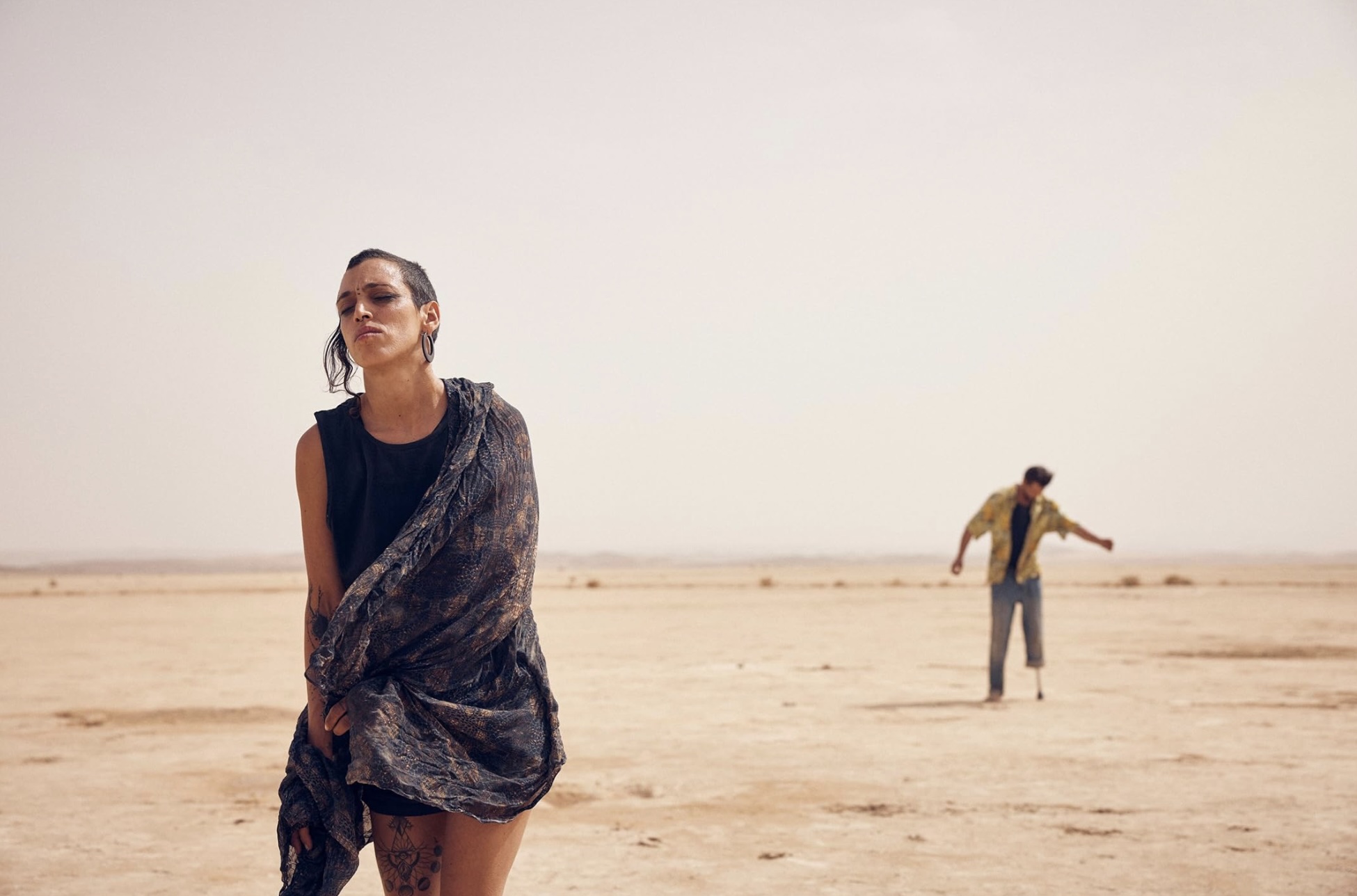
Have you ever been to a rave in the desert? I, for one, have not. In theory, I can imagine it being a good time, I suppose. But also, it seems like the kind of experience where you really have to push outside the structures of your day-to-day life in order to seek one out and participate. In the opening sequence of Sirāt, we see a roadie crew setting up a a pop-up rave out past the fringes of everyday society. Massive loudspeakers are carefully positioned in broad daylight in the middle of the vast and unforgiving deserts of southern Morocco, a stage set for hundreds of nomads to seek refuge to for as long as the music lasts. The camera cuts and pans around, focusing on five individuals in a large crowd of people dancing; these characters, all of whom are non-professional actors, will play important roles throughout the film. They're moving their bodies freely and with a kind of whimsy and enthusiasm that can only be conjured and expressed in this kind of communal solitude (and surely with the help of experimental drugs and hallucinogenics). At first glance, this isn't that dissimilar to a bunch of Deadheads floating around and swaying back and forth while Bob Weir sings Fire on the Mountain. And yet, the setting and semi-impromtu nature of this desert dancefloor seems different. What brings these people together? What are they searching for? What are they leaving behind?
For Luis (Sergi López) and his son Esteban (Bruno Núñez Arjona), it means searching for their missing daughter and sister, Mar. She's been gone a while it seems, or at least long enough for Luis and Esteban to decide to venture to this rave to see if they can find her. But she's nowhere in sight. According to the subgroup of dancing ravers we were introduced earlier, which includes Stef, Jade, Tonin, Bigui, and Josh, another rave will be happening soon deeper in the desert. Meanwhile, the current rave is broken up by a group of soldiers – European ravers in attendance are set to be evacuated, due to an escalating armed conflict that has commenced between two countries, described as a "World War III-like event." Despite the subgroup's attempt to dissuade Luis and Esteban from venturing deeper into the desert, especially given Luis is driving a compact car. They all caravan south, with the intention of finding the next rave, and for Luis and Esteban, hopefully Mar.
The first half of the film is essentially a road movie, an arduous journey into the difficult-to-navigate and unforgiving desert landscape. There's undeniable homage to movies like Mad Max: Fury Road and Sorcerer, where the specifics don't really matter, and you just need to hop on and enjoy the ride. The majority of the film's action is dedicated to extended sequences of trucks speeding across sweeping vistas or methodically trudging through rough terrain. By design,Sirāt is an overwhelming sensory experience, where the louds are loud, the quiet is quiet, the bright is bright, and the dark is dark. Cinematographer Mauro Herce and editor Cristóbal Fernández should be credited for their masterful control over and careful shaping of each frame, whether it be the musucular camera movement and positioning, or by way of the film's propulsive editing. The way the film feels is only accentuated by the pulsing, "feel it down into your diaphragm" rave music from Kangding Ray, which vibrates through many of the film's loudest and grandest sequences, as well as some of its most tender and intimate.
And all of sudden, almost out of nowhere, something happens that abrubtly triggers the film's second half. You'll know it when you see it, and you may not recover from what happens... I do want to safeguard the film's biggest reveals to preserve its shock factor, but just know that what Laxe has in store for the rest of the runtime is not for the faint of heart. The last hour of Sirāt does not pull a single punch, nor does it move in ways that feel familiar or predictable. All of that is a good thing, I'd say – at least until you reckon with the film's deepest questions. If you treat this film like a modern fable, where the characters are archetypal and the broad narrative strokes are meant to make you feel more than think, I think the film is very successful. There's a lot to chew on, in part because many of the story details are never fully fleshed out (e.g., that "World War III-type event"). But I want to circle back to the questions I posed earlier: What brings these people together? What are they searching for? What are they leaving behind? What does it mean when a film refuses to even attempt to provide answeres to the questions and mysteries it lays out? Depending on the kind of viewer you are and what you're looking for in a movie, your mileage may vary as to whether these questions are really answered, or at a minimum, addressed.
For me, the film's biggest shortcoming is that it fails to fully connect me to its characters and their story arcs. By over-relying on dramatic circumstance to push things forward rather than more character-driven motivations, I thought the film abandoned much of what was interesting about its first half. While I do think the use of non-professional actors was a savvy move to bring the audience in this very specific world, I was disappointed that many of the films most powerful moments were performative and maximalist rather than observed and introspective. More simply put, I thought some of the "whoa, holy shit" moments undercut some of the film's honesty and ethos, to the point where I found myself asking that tricky question when you're not exactly sure how you should feel by the end: what was this all for? I should clarify – I'm someone who often responds to an ambiguous, under-explained, open-to-interpretation ending! I think one of the most powerful tools a filmmaker has at their disposal is the power to leave their audience asking questions rather than having all the answers by the end of a film. In the case of Sirāt, it's not that I didn't like how it ended, but to me, it just didn't feel earned.
Overall, I left Sirāt feeling thrilled by its craft, impressed by its narrative bravery, and piqued by its thematic probing. Journeying deep into a literal desert to find one's family while figuratively delving into the desert of one's soul made for a challenging but memorable experience. Though I didn't completely buy into the depths of despair and bask in any newfound catharsis, I did stagger out of the theater and had a hard time shaking the film off – which I mean as a compliment. Make sure to catch this one at the theater and hand yourself over to it.
Froth
Back for more at Hop Butcher! Okay, you caught me, I might have sampled a flight during my last visit, sooo I might even have a few more to cover in the coming weeks. Here's a jet-black, heavy-bodied American Imperial Stout that has a dark-tan head and brings together two flavors that know each other very well: chocolate and peanut butter. This is their Fat Bear, which has a hefty 10.5% ABV to help you forget your problems but enough flavor to remind you that, yes, your taste buds are still working just fine. Creamy, roasty, and perfectly carbonated, this is another exceptional beer from one of Chicago's A-tier breweries. Normally, I'm headed to Hop Butcher for Hazy IPAs (which is prettyyy much what they're known for, I know), but I found this to be a delightful departure. And guess what? It's excellent! Everything they touch turns to gold. And in this case, that black gold tastes like a liquid Reese's Peanut Butter cup... with a much higher alcohol content. Drink this in while it's still around... I'm assuming this is on a rotation like most of their drafts?


