


Wuthering Heights

Film
Tragedy strikes when Heathcliff falls in love with Catherine Earnshaw, a woman from a wealthy family in 18th-century England.
Imaginative or misguided? Perceptive or oblivious? Sensuous or chaste? Transgressive or provocative? How far is too far and how far is not far enough? Just in time for Valentine's Day weekend comes a shit-stirring adaptation of "Wuthering Heights", written and directed by Emerald Fennell, a filmmaker whose greatest strength is being allergic to subtlety and agnostic to criticism. This is her third feature film, which follows her debut, Promising Young Woman (for which she won Best Original Screenplay at the Academy Awards), and Saltburn (for which she received zero Oscar nominations, for better or for worse, depending on who you ask). Currently projected to earn upwards of $50 million at the domestic box office (and potentially $70 million worldwide) in its opening weekend, this divisive (some may say reckless) retelling of Emily Brontë’s bleak and stormy masterwork will either turn you on or turn you off – or maybe even turn you off while trying to turn you on. Are you blushing or just bothered?
Spoilers aplenty
Recapping something as significant and singular as Brontë’s Wuthering Heights is, admittedly, a silly if not downright foolish exercise that will surely expose my fraudulence as a both a writer and thinker... so, here it goes! Charlotte's whiz kid younger sister was sadly a one-and-done author (she started writing Wuthering Heights at 27, it was published when she was 29, and she sadly died one year later); and yet, nearly 180 years later, the story of Heathcliff, Cathy, and those families of the West Yorkshire moors, has permanent staying power, and is a cornerstone of the Western literature canon.
Literary scholars recall that 'the vivid sexual passion and power of its language and imagery impress, bewildered and appalled reviewers'1, which apparently, led to many early readers to think it had been written by a man (nahh dudes, that's a girl boss, named Emily, she's using a sneaky pseudonym). If you're not familiar with the novel (I wasn't until just recently when I crammed in my first read-through), Wuthering Heights is more about violent and vengeful passion then it is about a true and idyllic romance. Romantic in theme and Gothic in vibe, the book is a multi-generational story of tragedy and trauma, its characters reckoning with love vs. obsession, social status vs. power, and revenge vs. reconciliation. Despite it's potency, it is dense, sprawling, and difficult to get your arms around; a true and pure adaptation that is uncompromisingly faithful to an Unfiltered Brontë™ would not only be nearly impossible to pull off, but it certainly wouldn't be easy to market or perhaps even sit through.
Which brings us to today: enter Emerald Fennell, who has made a film that pays homage and celebrates certain aspects of the source material, while also deviating in ways that are unapologetically subversive (sometimes for the sake of being subversive). Her Cathy is played by our Barbie, Margot Robbie (who also produced the film alongside her husband), and her Heathcliff is played by our Frankenstein's Creature, Jacob Elordi. Wait, let's pause right there, because for Brontë purists, this is already a misstep. Based on the text, both actors are far too old to play these characters, whom are canonically 6-7 years old when they meet and approximately 17-18 in the context of this retelling (Robbie and Elordi are 35 and 28, respectively). Oh, and more notably, casting Elordi as the racially ambiguous Heathcliff, described as resembling a "dark-skinned gipsy" or "Lascar" in the novel, is definitely controversial if not a bit irresponsible (put a pin in that we'll circle back in just a second). To round out the cast, Shazad Latif plays Edgar Linton, Cathy's to-be husband; Alison Oliver plays Isabella Linton, Edgar's sister and Heathcliff's to-be wife; and Hong Chau plays Nelly Dean, the steadfast housekeeper (ahem, servant) in the story, who also functions as the primary narrator in the novel... and is kinda, sorta framed as the de facto villain in Fennell's adaptation. Wow, yikes, okay, there are red flags everywhere. So, there's whitewashing going on, but also colorblind casting? Yeah, it's a lot (can we take the pin out now? No, not yet).
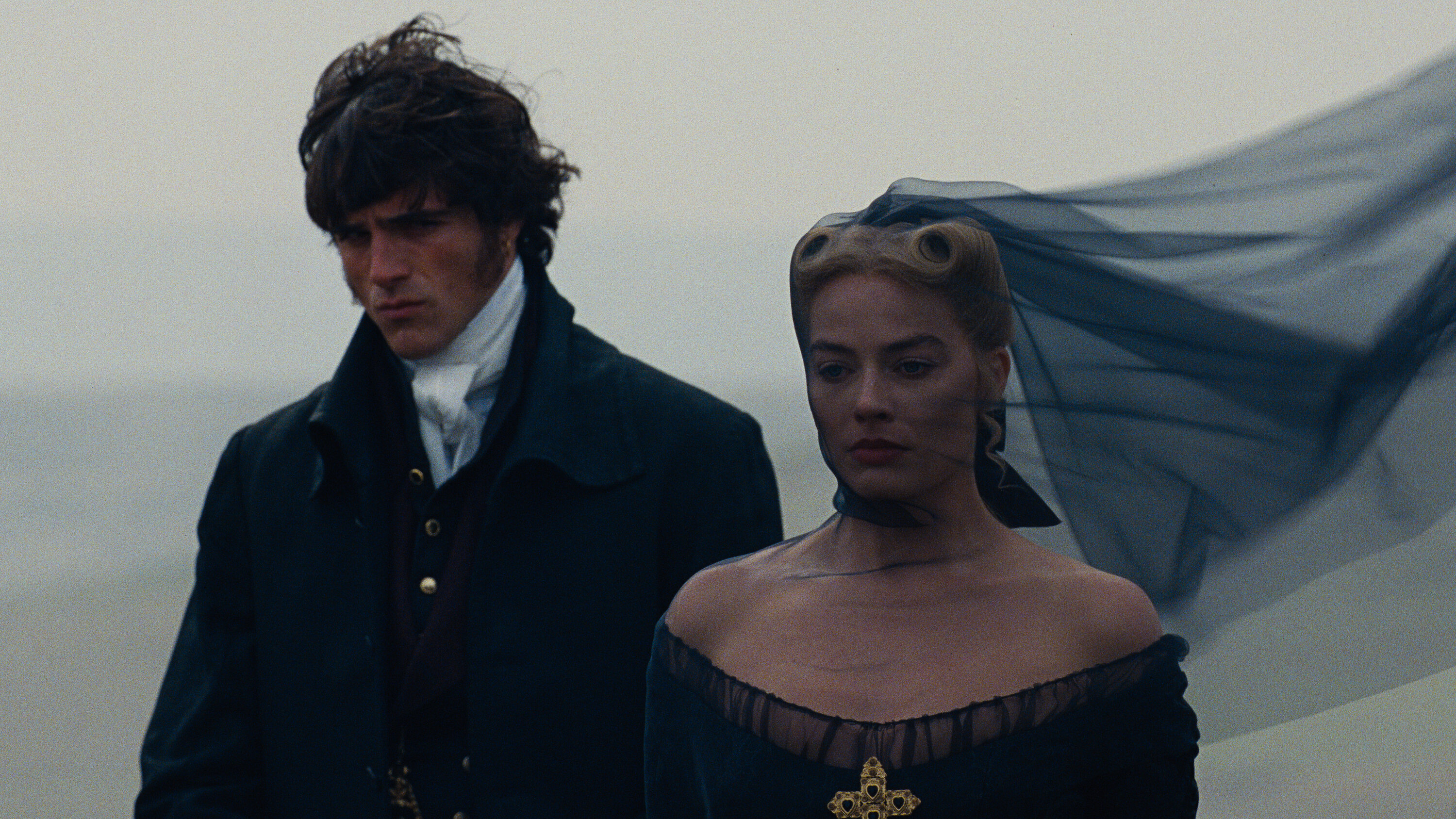
In stark contrast to Brontë, Fennell also radically departs from the novel narratively-speaking. Her script retrofits the story to accommodate her own cinematic interests, shamelessly cherry-picking bits and pieces of the all-consuming love connection between Cathy and Heathcliff. This is more or less Wuthering Heights fan fiction as envisioned by Fennell, leaving behind many of the intellectual and emotional intimacies and entanglements that lurk within every page of the book. Brontë's nuance and subtext is exchanged for something glossier and more chic, which happens to star two of the hottest people on the planet, no less. Maybe that isn't a good thing for the story, but you know what's not sexy? Class hierarchies understood by way of marriage, inheritance, and land ownership. You know what is sexy? Two smoldering celebrities brooding in a sweeping, atmospheric vista in costumes that are not period-accurate getting all hot and bothered, unable to resist one another while a Charli XCX banger is playing over the top. To many, that is, in fact, cinema! Now is the perfect time to compliment the production designer, Suzie Davies, costume designer, Jacqueline Durran, and cinematographer, Linus Sandgren, all of whom represent some of the best choices Fennell made in conceiving and executing on her vision for the film. Their involvement cannot be underestimated, and many of the best moments hinge upon their contributions. Remember Heathcliff appearing in the fog? Mhmm, that's what I'm talking about. And then Cathy's wedding veil blowing in the wind? Yup, that's what we're here for. In creating a memorable sensory experience, these filmmakers understand that this is horny Pride and Prejudice, or Bridgerton for the big screen, or Titanic without the boat. Sure, it's all a bit anachronistic and garish, but that doesn't mean it's insincere. To invoke Taylor Swift, someone whose cultural impact as an artist is imprinted all over this film (audibly and visually): "It's charming, if a little gauche."
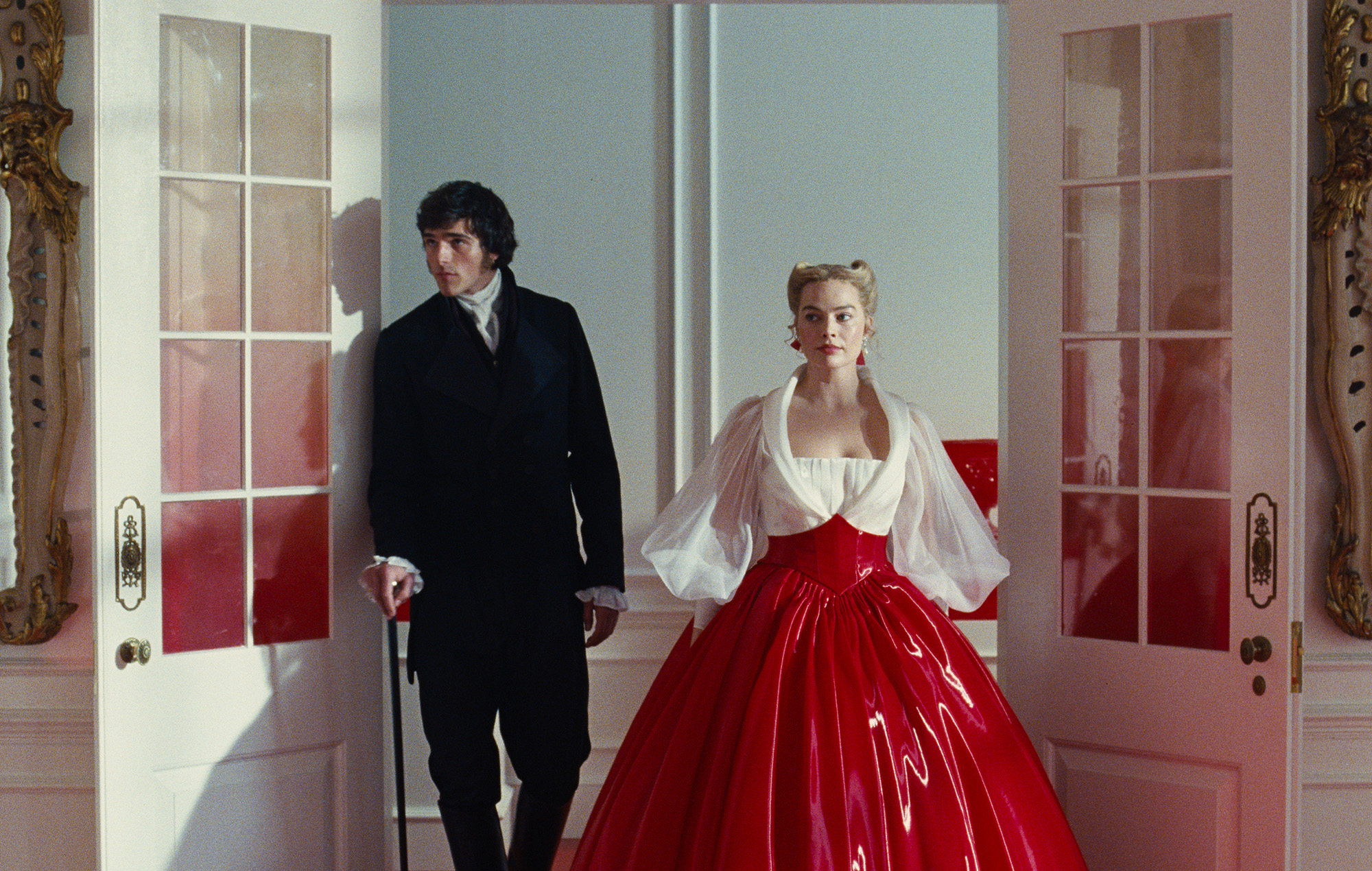
And with that, it is officially time to take out the pin. Yes, the casting is problematic, for a variety of reasons that we already touched on. Both Robbie and Elordi are a bit miscast if you're doing a text reading, but in Fennell's world, it doesn't really matter. They are both great actors – she can carry the entire emotional weight of a scene on her face, holding it all in before letting herself crumble at a moment's notice; meanwhile, he is stoic and restrained, a sad boy trapped inside his towering frame with great presence and vulnerability. And of course, they're both stunningly beautiful. Their chemistry is believable, but I never felt like they disappeared inside their characters. Maybe that's hard to pull off given some of the narrative concessions you have to make – don't overthink it, and it's fine.
What's more complicated is untangling what the film wants to be versus what it actually is. Brontë's Cathy and Heathcliff share a destructive love that is possessive, manipulative, and toxic – the romance they share is absolute but far from healthy. In Fennell's adaptation, much of this is either implied or more timidly presented. There is love and sex, there is yearning, control, and a lack of control. There's plenty of heat and attraction, and even a little bit of kink. But I'll point out, that in the book, Cathy and Heathcliff do not consummate their relationship at any point, which is a crucial plot point, especially in the context of the book's second half (where, SPOILER, Heathcliff tries to reenact his and Cathy's love with his kid and hers, which is as wild as it sounds). In my estimation, the best and worst part of Fennell's adaptation is that the film seems to be built on a what if: what if Cathy and Heathcliff had sex? In terms of the narrative, this is probably the biggest departure from Brontë and may very well be the thought experiment of which this entire film is built on. What if their attraction and love wasn't just theoretical? What if these two were more like star-crossed lovers à la Romeo and Juliet or Jack and Rose? This might be the point where LitHeads completely unravel, recognizing that this leads to less interesting character motivations and a shallower thematic pool to dive into. Whether by design or just as consequence, Fennell's adaptation isn't as much emotional trauma porn as it is Gothic smut. Well, in theory at least. "Gothic smut" is a great idea for a movie, but unfortuately, once Cathy and Heathcliff do the deed, the film falls a bit flat. Compared to their erotic foreplay, their sex scenes are relatively tame, and the sequence in the movie is made up of a montage rather than any one impassioned moment. If you're going to go for it, you have to go for it. I think this restraint is the film's greatest sin.
This all begs an important question that I probably should've addressed already: can one change too much or go too far off the rails in adaptation? And to build off that, is maintaining the spirit of the source material essential to delivering a good faith rendition of the story, or should that not matter? Your mileage will likely vary, but I'd argue the success of the film hinges on how you answer these questions. Personally, I have oft-held the opinion that, usually, one can't go too far and that artistic interpretation does not have to (and sometimes should not) strictly adhere to enacting a faithful rendition of a story – tightening the leash on when and which creative liberties can be taken is not a position I like to champion. Forgive my soapboxing, but I also think it is important that we (as culture consumers and critics) try and be as consistent as possible when assessing and/or ascribing what is or is not appropriate or worthwhile when measuring an artist's creative license.
Basically, live and let (artists) live. When an adaptation works, it works, and when it doesn't, well... then it is easy to say, "I told ya so" to the artist, isn't it? We didn't criticize someone like Paul Thomas Anderson last year when he made a fast and loose "adaptation" of Pynchon's Vineland – and guess what? His prior Pynchon adaptation, Inherent Vice more or less flopped commercially and was mostly misunderstood in its time, somewhat in part because it was too faithful of an adaptation. Damned if you do, damned if you don't, eh? Because I'm a bandwagon, Johnny-come-lately to Brontë's Wuthering Heights and had mere days in between finishing the book and seeing the film, far be it for me to tell anyone whether Fennell's adaptation is too far of a departure from the source material. I'd be a liar if I didn't admit that I found it difficult to get over some of these thematic hurdles; that said, it doesn't mean I don't think Fennell is within her right to make the make the film she wanted to make – we, as viewers, retain the right to like it or not. Sure, it's hard to fully reconcile some of her creative choices, and no matter how much Fennell insists they are in the spirit of Brontë, they feel like some decisions are done so in spite of her.
Like most films, how you receive it and what you take from it is intrinsically tied to what you bring into it and what you expect to get out of it. For those loyal to the source material, "Wuthering Heights" (Emerald's Version) will at a minimum test your patience, though it may just as easily piss you off. For those new to the story and for readers not clutching their pearls, this adaptation is an easy sell, an event movie in the dead of winter strategically premiering on a horny holiday weekend designed to stimulate audiences and of course, meet modern expectations at the box office. Like it or not, love it or loathe it, this film is meant to titillate and torture, for pleasure and for pain. Leave behind your wuthering, wuthering, wuthering... oh, for the love of all things sacred, put a cork in it, Kate.
Froth
The Double Blazed Orange Milkshake IPA from Hop Butcher for the World is one of the best beers in Chicago. Have I said this before? Have I reviewed it before? Dude, I don't know. Time is flat circle, and we're so done the wormhole that I'm just happy to be on the ride these days. I've definitely drank it before! And you bet your ass I'll drink it again. After talking to the bartender, it sounds like it is only released a few times a year. He mentioned that a lower ABV version of it will be available again soon after this goes away again (sounds like we're nearing the end of its run, so I might need to stop in one more time this weekend). I'm ashamed to admit that I was very late to the party when it comes to Hop Butcher, which is inarguably one of the best breweries in the city. Their quality, their constant reinvention, their flavor profiles. I can't recomend them enough. I had this draft AFTER seeing "Wuthering Heights", and it really helped me power through my many thoughts on the film. Whether or not the movie will linger as a major film for Fennell is unclear, but Hop Butcher's Milkshake IPA is absolutely a major beer from a major brewery. I wish I received a cut from this praise. Their contributions to the world are enough for me, I guess.
- Juliet Gardiner, The History today who's who in British history (2000), p. 109↩


