


Good Luck, Have Fun, Don't Die

Film
It only makes sense that we're blessed with an exceedingly comedic and twisted take on The Matrix this week. After all, the Super Bowl was filled with AI commercials, including one from a certain camera company that labeled their new robot overlord surveillance system as a means to find lost puppies. Maybe that's an unfair comparison but when an unnamed man from the future (Sam Rockwell) zaps into a diner, sporting what appears to be trash as fashion so he calls it, to recruit so-called "warriors" to stop the creation of an AI that has taken over in the years to come, it's hard not to think about the Wachowski's seminal film. But, Rockwell's Man From the Future is no Neo (Keanu Reeves) and the martial arts is forsaken for increasingly caustic humor, a homeless man with a machete, and a gigantic kitten-centaur-monster that burps confetti. Yes, this is a real movie I'm talking about, and yes, it is Gore Verbinski's Good Luck, Have Fun, Don't Die. A movie that, within all of its outrageous episodic reveals, crafts a singular story through poignant and incisive satire, shredding the current status of the world (but mostly the United States) into ribbons, resulting in one of the most exciting, uproarious, and devastating watches of the year. It may be just shy of a decade since Verbinski's last film, but he hasn't lost a step. Good Luck, Have Fun, Don't Die is the shot of anti-AI and anti-bullshit that we desperately need.
Rockwell's rousing oorah who's with me speech in the diner starts the film off with a very classic David vs. Goliath feel. An unspeakable evil is right around the corner, and there is some special combination of people in the diner that can defeat it. How does Rockwell's oddly specific character know this? Well, he's "replayed" this moment hundreds of times, introducing the depths his character will go to in order to be victorious. As far as time-loop films go, Good Luck, Have Fun, Don't Die is a freshly entertaining mix of the humor in Groundhog Day, the film even getting a reference in Rockwell's speech, and the sci-fi high stakes battle of Edge of Tomorrow. Although Verbinski's film doesn't sport the epic action of the latter-mentioned film, it unveils its intentions through three carefully articulated anthologies for members of the diner's "War Party." Making it an exciting and suspenseful reel of thematic reveals and building on the characters in a way that is gripping, and once again, wickedly funny (even if extremely bleak).
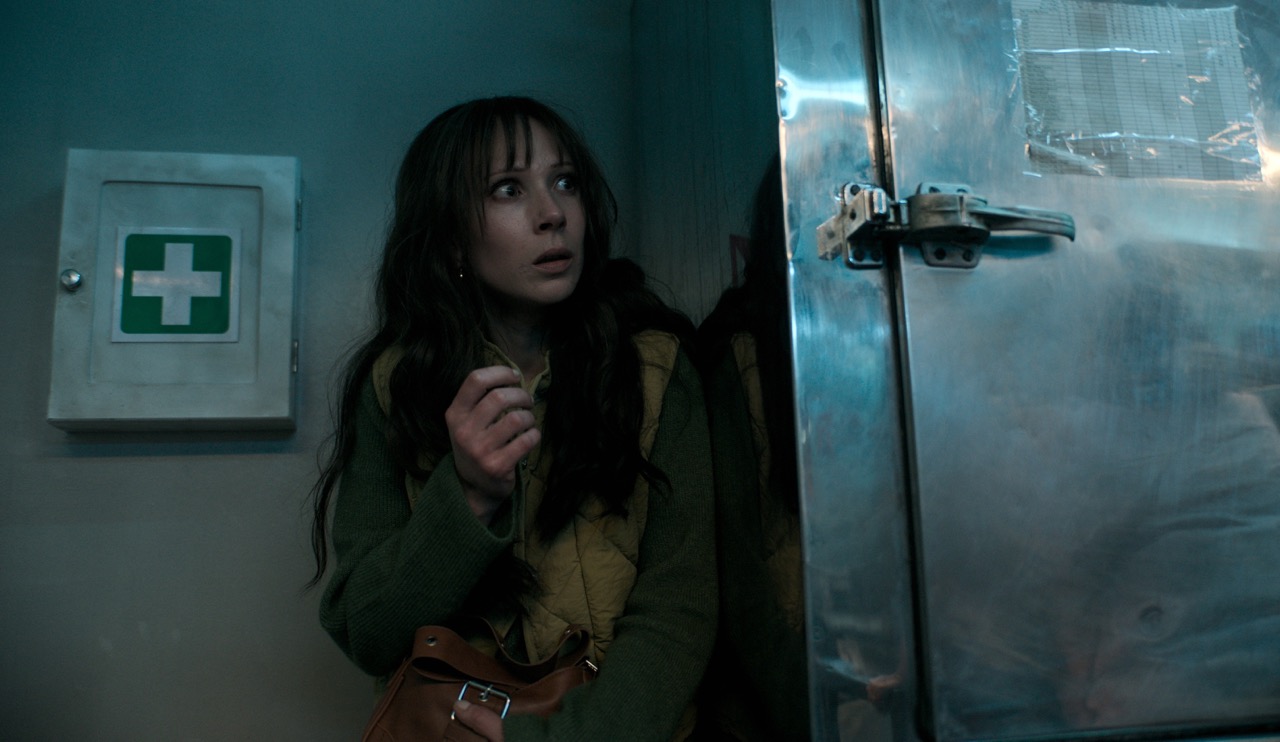
Mark (Michael Peña) and Janet (Zazie Beetz) are teachers and troubled lovers, who showcase one of the problems with the youth in the world. When the kids in school aren't glued to their phones, unironically always showing a type of TikTok interface, they're sheltering from an extremely casually announced school shooting where they eviscerate their teachers' self-esteem. Building upon the technological dependence of teens and tweens, along with the grim reality of school shootings, introduces Susan (Juno Temple), who is grieving the loss of her son, a victim in a separate shooting. Appearing to find solace with a support group of fellow moms, who nonchalantly pity Susan for her "first time," Susan is instead brought to a futuristic facility where the government will pay for a clone of your lost child. Not only is Susan's grief boiled down into a government subsidy, but her son's existence is relegated to a list of character traits where she can only select one. And last, but not least, the final vignette is of Ingrid (Haley Lu Richardson), a young woman who seemingly is allergic to cell and wifi signals. She finally meets a man who shares her analog ideals, but he eventually abandons her to go live in a permanent virtual reality. If there's a character in this heroic party of diner-goers that doesn't receive a special segment, well, that's because Rockwell's Man of the Future told us that "not everybody is gonna make it to the end."
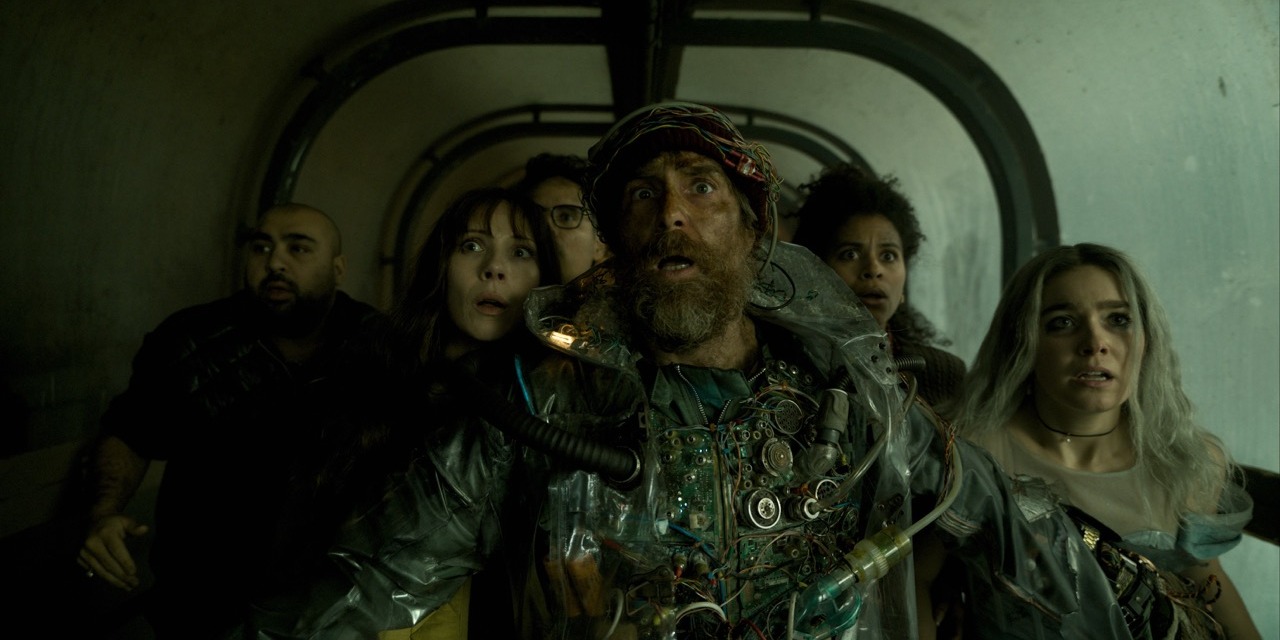
Robinson clearly has a lot to say about the state of the world. And we could 100% focus this mainly on the United States. Younger generations being addicted to social media or even technology at large, something the Man From the Future claims spawned from morning phone time, is one of the lighter commentaries of the film. But the big picture items of the screenplay, which plays perfectly with Verbinski's ability to display dark humor tastefully (a tall task in this film), is the clear and present danger of unregulated AI, and how we as a society would rather apply technological band-aids instead of look in the mirror and make policy reforms. Susan's section of the movie takes up a good part of the second act and is by far the heavy hitter of the trio. It builds tremendously off of Mark and Janet's, while setting up the emotional heft of Ingrid and the Man From the Future's stories. But it's the balancing act that Verbinski employs that impresses the most. The mixture of gasps, sighs, and laughs coming from such a terribly tragic story is so pitch-perfect that the emotions that boil to the surface are tough to fully comprehend. Good Luck, Have Fun, Don't Die is not only immensely entertaining in this regard, but effectively challenges why we accept the status quo of the present when the future looks just as, if not more, grim.
The third act does pose a few issues, though, causing Verbinski's juggling act to stumble a bit. As the diner party pushes onwards in their mission to stop a kid from creating the AI that destroys the future—very Terminator I know—reality folds into itself just like the narrative. For the bulk of the film, the setting could almost be thought of as an exaggerated year from today, making it all the more insightful and incisive in its satire. But when a kaiju kitten-centaur that burps confetti graces the screen, along with what the Man From the Future calls "mindfucks," it loses a lot of its steam. The introduction of a giant monster feels disingenuous from the prior moments of the film that were much more effectively told. Not to mention the big bad AI trying to survive by offering a life in virtual reality, where there is no disease or strife, is a pretty good monster itself.
Regardless, Good Luck, Have Fun, Don't Die is a total blast, and a welcome return from Verbinski, nine years after his A Cure For Wellness took more of a horror approach to capitalistic battles. His penchant for using mordant wit to tackle incredibly serious topics is still razor sharp, and his direction here is as sturdy as ever. The script is the perfect vehicle for Verbinski's maniacal vision, and of course, Rockwell's charisma gives the whole project the performance it deserves. The rest of the cast works well, even if Rockwell does much of the heavy lifting, but Temple and Richardson excel in their roles, teetering between comedic and heartbreaking and doing so with aplomb. Ultimately yielding an enthralling cinematic vision that continues to push back against the ever-expanding shadow of artificial intelligence and its encroachment on the human experience.
Froth
For Verbinski's gloriously fun return to film I went with an equally exciting beer from Baerlic Brewing Company, the Frequency Illusion West Coast IPA. Exceptionally hoppy and with a solid bitterness, especially on the back end, the Frequency Illusion is a complete classic of a West Coast IPA. What you're expecting, is what you're getting. But it also finds ways to crank that up a notch, surpassing some expectations especially in its smooth and clean drinkability, piney subtleties, and wealth of tropical flavors like peaches, mango, and pineapple. Brewed with the textbook trio of Mosiac, Simcoe, and Citra hops, Baerlic Brewing (in collaboration with Block 15 Brewing) really turned in an easily drinkable, repeatable, and delicious classic of a staple brew. I would absolutely watch Good Luck, Have Fun, Don't Die again, and I would assuredly have a nice big pint of Frequency Illusion with it.


