


Fatherland


Film
Paweł Pawlikowski's loose trilogy, starting with Ida and Cold Warand retracing the survival of art and culture after WWII through Polish and German lenses, comes to a satisfying, if not extremely dense, conclusion with Fatherland. Continuing these themes, Pawlikowski focuses entirely on post-war Germany and the literal ideological divide. Western versus Eastern, Capitalism versus Communism, United States versus Soviet Union are all more on-the-nose aspects of Pawlikowski's thesis. But the Polish-born philosopher-turned-documentarian is more keen on the human elements of this, not mere ideological debates.
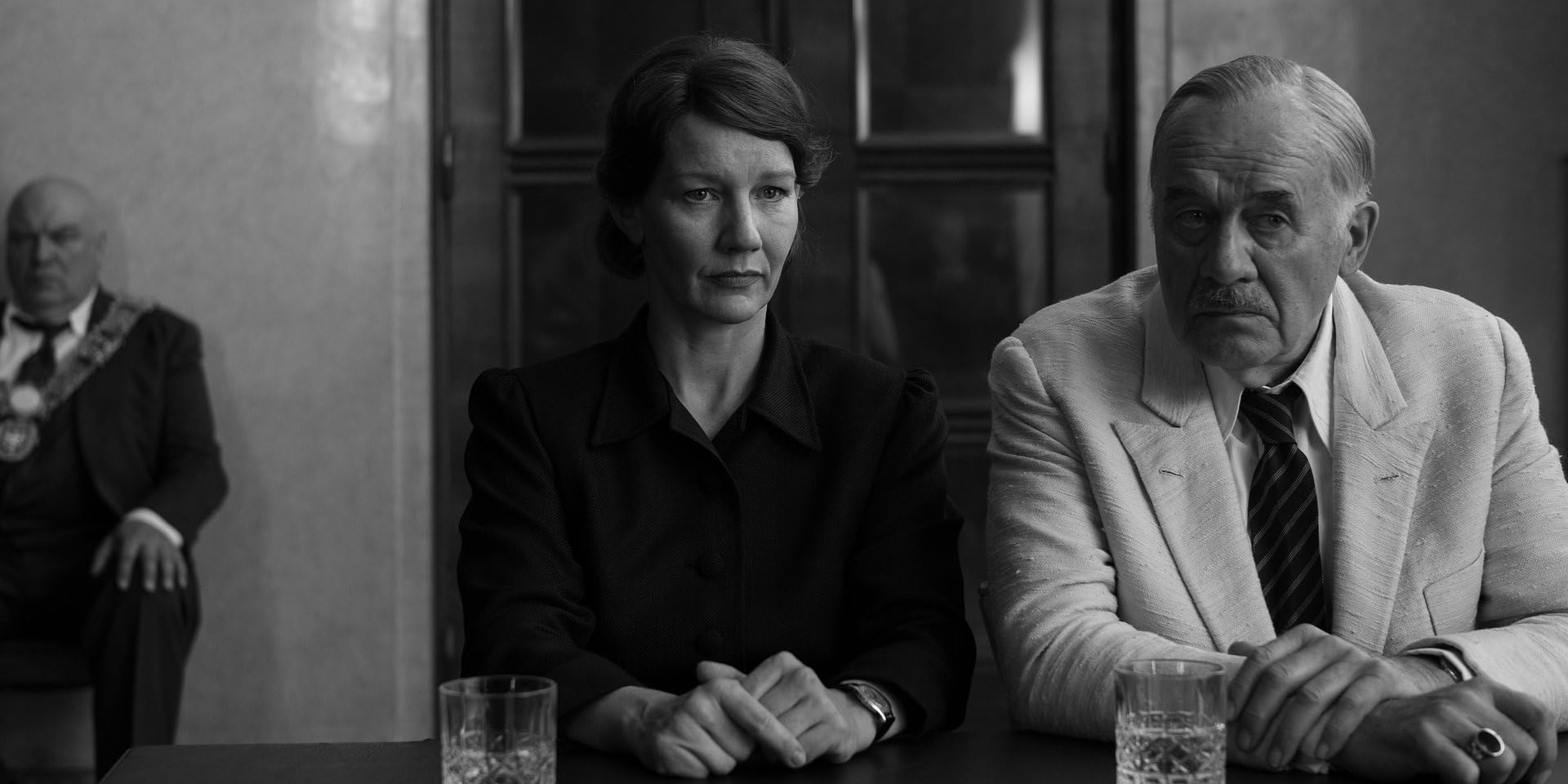
Pawlikowski doesn't waste any time setting his stage. He wants it to be abundantly clear that there is no grey area in these varying arguments. It's black and white. Figuratively and quite literally, Łukasz Żal's black-and-white cinematography paints simple, yet outrageously gorgeous images. Yielding some of the most elegantly restrained images makes Fatherland a visually intriguing and stunning display of artistic expression. So when the film leans more into the value of art in a culture, its perseverance across regimes, along with what art legitimizes, the visuals evolve into something even more beautiful. An image as subdued as Erika (Sandra Hüller) sitting on a couch is enough to knock the wind out of you. I'm not exaggerating when I say some frames in this film could be in art museums across the world. There's an otherworldly simple beauty that is irrefutable.
I'm not the only one to think such things. Thomas Mann (Hanns Zischler), an exiled German writer, is returning to Germany to deliver speeches from Frankfurt to Weimar, where he is set to receive the Goethe Prize in both cities, while his daughter Erika accompanies him. Their trip through the West is filled with extravagant halls, dinners, celebrations with drinks and food, whereas the East is empty. Between the stops are plenty of Pawlikowski's academic writing, with the help of co-writer Henk Handloegten, which can distance one from the actual film. That is, unless you're well-versed in the German arts and culture. I, sadly, am not, but I was still able to discern the idea that Fatherland constructs. One of the earliest moments is the grandchildren of the German composer Richard Wagner asking Thomas to endorse the revival of Wagner's Bayreuth Festival. During the Nazi regime, Winifred Wagner helmed the festival and was a known close friend of Adolf Hitler. Thomas understands this endorsement is meant to legitimize, if not erase, the history of the festival, along with Winifred's closeness with Hitler, which he refuses.
The same idea goes for his acceptance of the Goethe Prize in Weimar. Does his acceptance of an award for literary works, an essential element to a successful society and culture, further legitimize the split of Germany? For someone who lives in the United States (in exile), how will his home receive him after legitimizing the Soviet society in Eastern Germany? It's a terrifically written debate, and Zischler and Hüller are phenomenal in their engagements with one another. Hüller's Erika represents someone much more in tune with the human aspect of this whole ordeal, while Zischler's Thomas is overly idealistic in the world's view on art and culture. When a family tragedy impacts the Manns, this same notion takes a more personal effect. Erika is attempting to confront grief while Thomas buries his emotion behind the walls of his work.
Even amidst all of the academic dialogue, beleaguering my under-learned mind, I found Fatherland utterly mesmerizing. If there's one moment I can point to outside of the aforementioned moments, it would be the full-circle finale that moved the film from my brain to my heart. An emotional finale between Thomas and Erika, unraveling in that stupendous black-and-white cinematography after one of the sharpest 82-minute films I can think of (there's a reason Pawlikowski won Best Director at Cannes), was outright tremendous. A sensational ending that has made me want to revisit the film more every day and dive deeper into the incredibly dense arguments Pawlikowski presents to us.
Froth
The defining element to Fatherland has to be Żal's cinematography. If you couldn't tell by my feverish appreciation of it before, let me just say once again, it's damn good. And if you're going to have a black and white film, you may as well have a black beer. Like, super black. Fremont Brewing's annual bourbon barrel aged version of their imperial oatmeal stout is the perfect dark beer for such an occasion. This year's release, per Fremont Brewing, uses "a blend of 24, 18, 12, and 8-month Bourbon Barrel-Aged Dark Star in 7-12-year old Kentucky bourbon barrels" and boy oh boy is it smooth. Boozy warmth, it is 16.4% after all, is a delightful companion to the sweet chocolate and roasted malty flavors from the Dark Star brew. The only overwhelming factor here is how good this is, but I can see how some might be intimidated by how potent of a flavor profile it has. Like other bourbon barrel aged brews it definitely packs a punch, if not multiple rounds of sweet and strong flavors and aromas. But on a cold, crisp day, it htis the spot better than most.


