


Backrooms


Film
A strange doorway appears in the basement of a furniture showroom.
“What the hell is creepypasta?” – is a question you might ask yourself if you are one of those old-as-the-hills, “my algorithm mostly consists of cats and hydraulic press videos” millennials. You know, those of us who grew up alongside the internet but can still remember life before it completely monopolized every second of our time and attention? To spare you the research (and to catch you up with all your Gen Z comrades out there), creepypasta, as covered by the New York Times circa 2010(!!) in quite possibly the most ‘How do you do, fellow kids?’ way possible is “bite-sized bits of scariness that have joined the unending list of things-to-do-when-you’re-bored-at-work”. What the hell was going on back in 2010?! What a simpler time indeed. Anyways, creepypasta is one flavor of the wider vernacular of internet meme culture, usually derived from scary images/stories/content posted to the internet that gets passed around and develops its own lore. When explained that way, I know l was watching creepypasta, I just didn’t know it as such. This year, a breakout horror movie was released called, Backrooms, which has gone on to be the highest grossing A24 film of all time; it is an adaptation of the YouTube series of the same name, both of which were directed by a 20-year-old whiz kid, Kane Parsons. While it isn’t the first creepypasta to be made into a feature film (may I reintroduce you to Slender Man, Backrooms is in the lineage of internet-born horror movies that are now becoming increasingly prominent and successful at the box office.
Horror remains the most recession-proof genre there is, since these movies often offer such a low-cost, high-yield value proposition. As horror gradually creeps towards the center of movie culture (thanks to a filmmaking class of high-caliber auteurs that have rose to prominence in the last decade, à la Jordan Peele, Ari Aster, and Zach Cregger, to name a few), we’ve seen more up-and-coming horror filmmakers get an early bite at the directorial apple. Remember Talk to Me, a debut feature film for the Philippou brothers, Danny and Michael, who made their bones making comedy horror videos on YouTube as teenagers? That film was acquired out of Sundance in 2023 by A24, which looking back was an early bet on this yet-to-be-tapped-into pipeline of potential filmmaking talent. But really, it took another three years before the sea change would really happen, which brings us to current day – we are now fully experiencing that watershed moment in horror moviemaking, as evidenced by the overwhelming success of Curry Barker’s Obsession and the movie at hand, Backrooms.
Normally, I’ll include a “Spoilers aplenty” disclaimer in my reviews to ensure that those of you casually perusing who like to live dangerously and feel the rush of flirting with being potentially exposed to spoilers are properly informed and have a last-minute escape plan. In this case, I’m not sure it’s even worth including a disclaimer since Backrooms is such a difficult movie to describe and explain in the first place. Prior to seeing it, I did some prep work and went back to watch a few of the OG videos of “the backrooms” from Parsons’ YouTube web series; for those of you wondering if you should check them out before seeing the movie, I’d say that it probably wouldn’t help or hurt either way. Seeing even just a few of the videos, I thought I got the gist of it – most of them were fairly short but still pretty effective, and even as a teenager, you can see Parsons’ potential and knack for building suspense and scary image making.
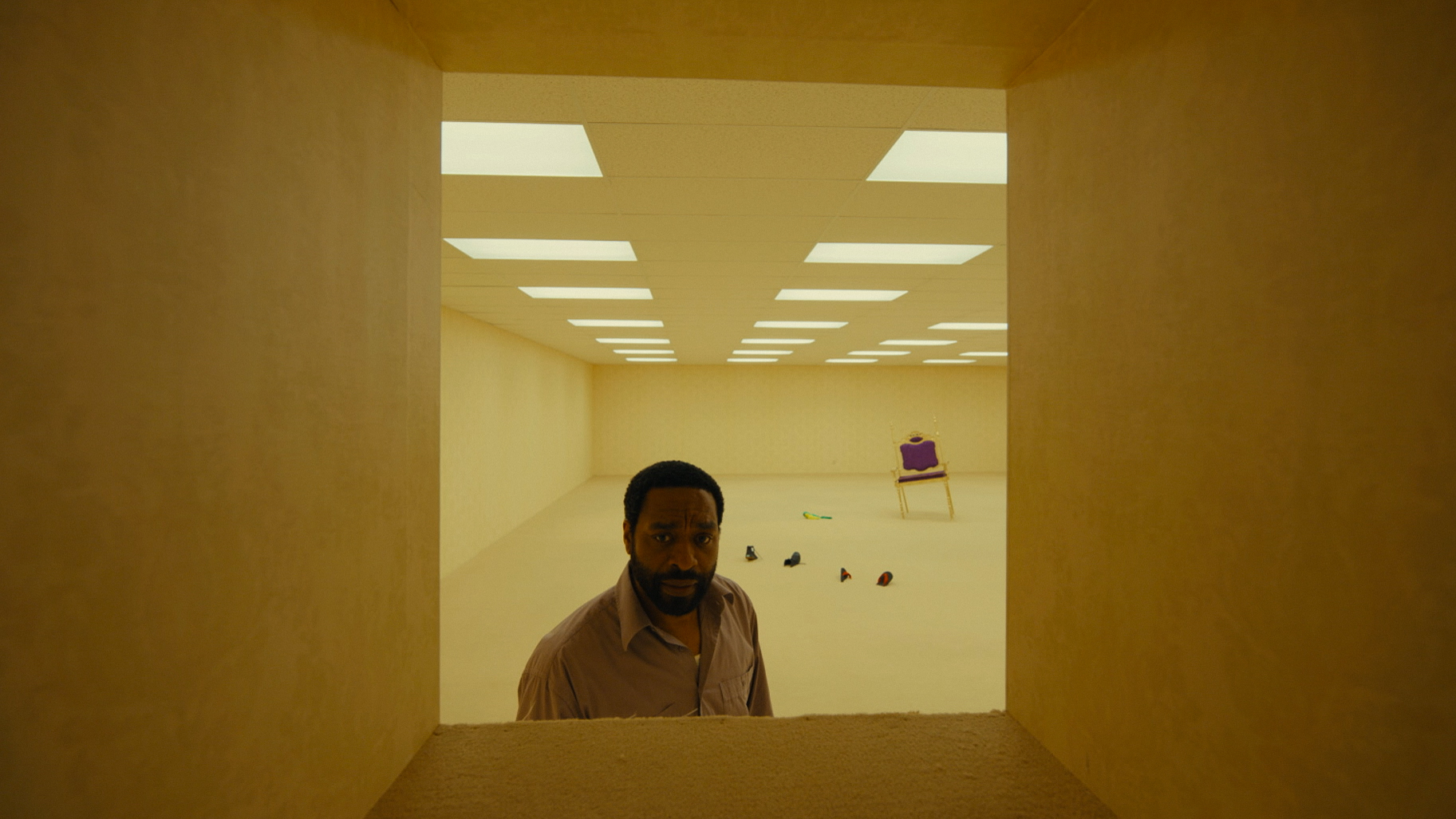
With his feature-length debut, Parsons has all the luxuries and creative opportunity a $10 million budget from an A-tier movie studio can provide an aspiring filmmaker. On top of having a slew of big-name filmmakers involved on the backend as producers (including James Wan, Shawn Levy, and Osgood Perkins), the film boasts some top-notch acting pedigree, including Chiwetel Ejiofor, Renate Reinsve, and Mark Duplass. Without trying to describe something that should absolutely been experienced rather than explained, I’ll do my best to give you just enough to go on. Backrooms employs psychological horror, the kind of scariness that takes shape differently in one’s brain depending on who you are as a person. All you really need to know going in is that Clark (Ejiofor), a furniture store owner who is having a rough time both personally and professionally, discovers a hidden doorway (in the basement of his store) to an eerie and endlessly large, extra-dimensional labyrinth of yellow-hued rooms and buzzing fluorescent lights, which we understand to be “the backrooms.” His therapist, Mary (Reinsve), shows up at his store after receiving a cryptic and concerning voicemail from Clark, only to discover he be lost, in more ways than one. The liminal space of "the backrooms" aesthetic has a familiar feel – like an expansive maze of office buildings, hotels, and shopping malls and that are interwoven with one another. But these rooms are all empty and desolate, and you can’t help but feel like you’re being watched or followed. It’s worth saying right now that the visual construction and production design of “the backrooms” in this film are insanely impressive and worth the price of admission – they’re so bizarre, unsettling, and create a palpable sense of dread that feels revelatory for a horror movie.
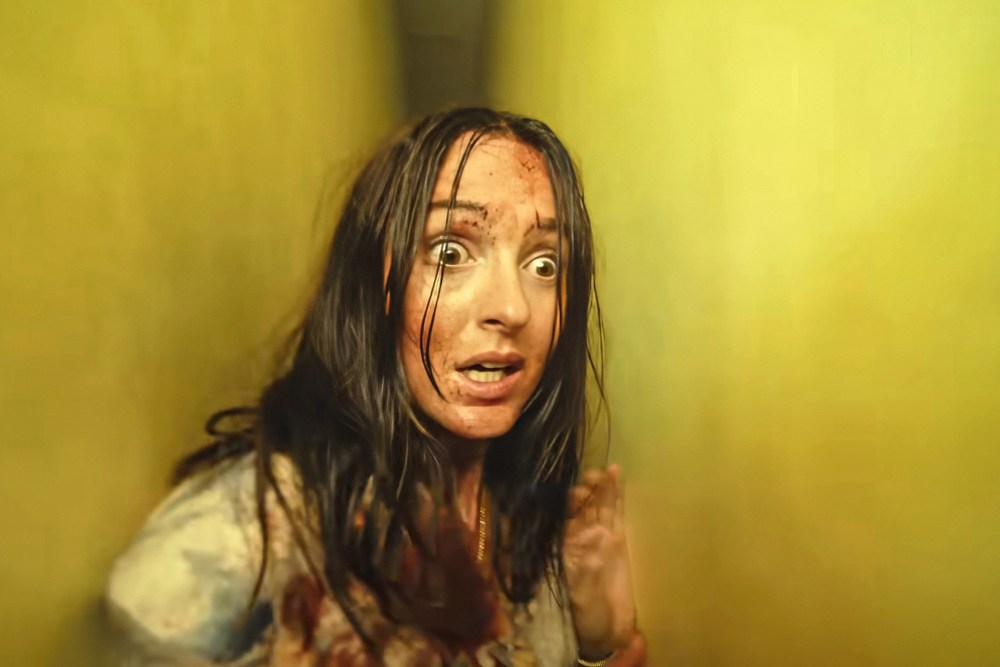
What holds the movie back is not the conception and creation of “the backrooms,” the film’s memorable imagery and suspenseful pacing, the committed the performances, or even the answer to the question of “is there someone or something else in here with us?” Maybe this obvious, but Backrooms is great when we’re actually in “the backrooms.” What held the movie back for me is the story built around “the backrooms.” The script insists on shoehorning in a hodge-podge spread of familiar horror themes to rudimentarily explain the inexplicable mechanics and lore of this world – rather than just trust the audience to sit in some uncertainty and hand themselves over to the unknown. While I understand the studio’s desire to round out the story and give the audiences some frames of reference and round out the characters we’re following on this journey, I found myself losing interest every time we left “the backrooms” and spent time in the real-world. Moreover, trying to provide a backstory and explain any of the “why” or “how” questions that make “the backrooms” so fascinating to begin with feels like a misunderstanding of the material. I really don’t want to put any of that blame on Parsons, since most of what I was frustrated by seems like obvious notes from studio executives and the powers that be. I mean, they were probably right, since audiences came out in droves, leading to a massive box office return. Still, I think there’s a better, tighter movie in there that does away with most of that window dressing – or at least there’s a better version of the B-storylines, which I do recognize are important for sustaining the audience and not burning them out too fast.
In a year when films like Backrooms and Obsession are taking the movie world by storm, there is certainly a lot to be excited about happening in the horror genre. Despite any of my reservations about Backrooms, it is undeniable that Kane Parsons has “it,” and I’m really glad he got the opportunity to make his feature film debut – and I’m glad we all got to see it. In fact, the best thing about Backrooms may not even be anything in Backrooms - it may be the arrival of Parsons as a filmmaker and the promise of what could come in the future. It’s hard to get anything made, and it’s even harder to make something that audiences haven’t seen before. With Backrooms, Parsons already was able to accomplish that. What were you doing when you were 20? If you were like me, you probably were probably watching creepypasta videos on YouTube, not knowing what was to come.
Froth
I saw Backrooms at the Alamo Drafthouse in Wrigleyville (boo, Cubs) in Chicago on a Tuesday night. I know we aren't supposed to go to Alamo anymore, and I apologize for that, but I felt like I had no choice if I wanted to see the film on the big screen. Now that I'm done explaining myself, I ordered a Kölsch from one of my all-time favorite spots in Chicago, Middle Brow! Whenever I see one of them on a tap menu, I have almost zero control over my decision-making functions and up ordering one of their beers. Yard Work is most certainly a beer I have had before, but I couldn't clock it. Awe man! Darn, I guess I'll just have to order one and remind my taste buds! But what's important here is not about the beer, nor is it about the movie – it's about what happened after the movie. At this particular Alamo, the elevators get bunched up, since the building is shared with other businesses. When a movie lets out, you might get stuck waiting to make it down two stories to your car. On this particular night, I opted to find a stairwell to avoid the jam. What a huge fucking mistake that was. Why? Well, the massive stairwell I found was completely other than myself, and every step I took echoed as if I was the only person in Cook County. Talk about about a liminal space, which is exactly where you want to be after seeing Backrooms. All this is to say, I'm glad Yard Work boasts a modest 4% ABV, otherwise I might've been even more paranoid leaving the theater. So, thank you Middle Brow for thinking ahead and protecting my psyche and senses when brewing this batch.


![It Would Be Night in Caracas - SIFF [2026]](https://images.ctfassets.net/f4exvld7r7c2/5ktcPKILpgJTxbnLk1E2r2/825958723d582a6a959dba15442df3b7/ItWouldBeNightInCaracas_KeyArt.jpeg?w=400&h=200&fl=progressive&q=50&fm=jpg)


![It Would Be Night in Caracas - SIFF [2026]](https://images.ctfassets.net/f4exvld7r7c2/5F8wGEQRPR6X5OGYEqFe2r/697a305349bb729092adca4e6100c202/Lady_KeyArt_Large.jpeg?w=600&h=300&fl=progressive&q=50&fm=jpg)