


Woman Unknown - TIFF [2026]

Film
Marie, a former housekeeper, plans an extravagant dinner party for her engagement to the household’s patriarch. As preparations unfold, hidden aspects of her past begin to surface, threatening to disrupt the celebration.
Woman Unknown arrived at TIFF with some pretty impressive credentials, having just won the Golden Lion at the Venice International Film Festival, where Mathilde Arcel also won the Volpi Cup for Best Actress. Directed by May el-Toukhy, the film is set in postwar Copenhagen and follows Marie (Arcel), a young housemaid and nanny who is preparing to marry her wealthy employer, Christian (Carsten Bjørnlund). As she’s on the verge of starting her comfortable new life, her livelihood is threatened by a secret she tried to bury in her past: a romantic relationship with a German soldier during the occupation. Newly liberated Denmark and its traumatized populace have become increasingly eager to punish women accused of fraternizing with the enemy, and Marie is desperate not to lose the safety and security that would come with her marriage.
Spoilers aplenty
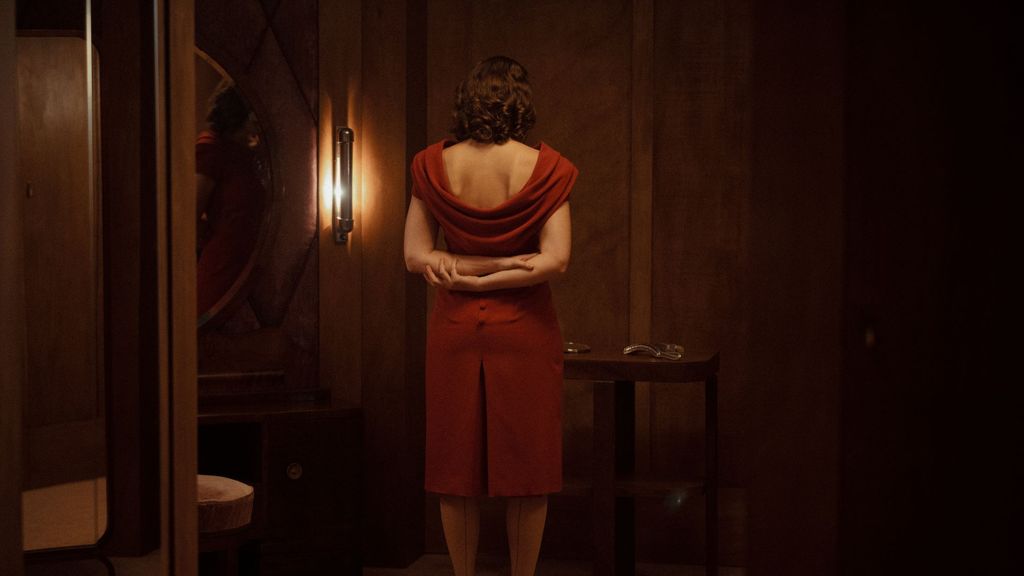
The film is an extremely slow-burning (and I mean SLOW) psychological thriller that takes its sweet time letting the walls close around its protagonist. Let me just say, the pace is, at times, almost glacial. If you’re looking for something to keep you on the edge of your seat with the sort of cinematic tricks and tropes that you’d usually expect from a thriller, you may be disappointed. But El-Toukhy has such commanding control over this material – she isn’t particularly interested in rushing between scenes to build tension and instead rewards the audience's patience through subtle hints and clues about where things are headed through awkward encounters, lingering glances, and deliberate staging. Woman Unknown is all about building an atmosphere of unease and about watching Marie try to keep her carefully constructed life from falling apart. For me, I found that once I bought into how the film is going to gradually parse out its reveals, I was captivated despite how slowly events were unfolding.
Another aspect of the film that I appreciated is Arcel’s restrained performance as Marie. There’s so much that is unspoken or unexplained about her as a character, and I thought the film did an excellent job of using some of the baked-in ambiguity of her history and motivations to enhance the suspense of the film rather than shoulder it entirely. There’s a version of this film that might have made Marie a purely sympathetic protagonist – to its credit, Woman Unknown presents Marie as a fully realized and complicated character, someone who has made mistakes but ultimately done what any of us might have done in her situation – tried to survive at all costs. In pursuit of her self-preservation, the film avoids some of the more obvious and exhausted tropes of a conventional female victim narrative. Moreover, I thought the film was clever in the way it presented certain juxtapositions and hypocrisies of this world during this time. For example, the elegant interior comforts of Christian’s house that come with Marie’s soon-to-be status are in stark contrast to the war-torn ugliness and calloused despair happening outside. The film feels like a critique of postwar hypocrisy, where a society can condemn women for their wartime relationships while overlooking the profiteering that many men and institutions had during that same occupation. These takeaways are not all that revolutionary, but they are carefully established and subtly delivered without the kind of hand-holding that can immediately undermine the point being made. It’s powerful writing delivered with a sleight of hand that is commendable.
That said, my biggest knock against Woman Unknown is the film’s almost stubborn unwillingness to ever fully (or even partially) reveal the cards in its hand. I do respect the restraint, but I did feel somewhat unfulfilled by the time the credits rolled considering the level of investment I had scene-to-scene. Not every question needs to be answered, but at a certain point, you begin to question the director’s creative intention and whether the story had a hollowed-out center. It can be satisfying to put all the puzzle pieces together and make some logical leaps along the way, but there is something inherently dissatisfying about a true lack of resolution, as if your 1,000-piece puzzle had a dozen random pieces missing. Still an engaging endeavor, but frustratingly incomplete. But then again, isn't that true to life? We're rarely afforded the luxury of certitude.


